 Dunja Cvetković
How to opt out of your friend
November 18, 2026 · 7 min
The EU wants to let you switch off a chatbot that acts like your friend. Somebody has to design that switch.
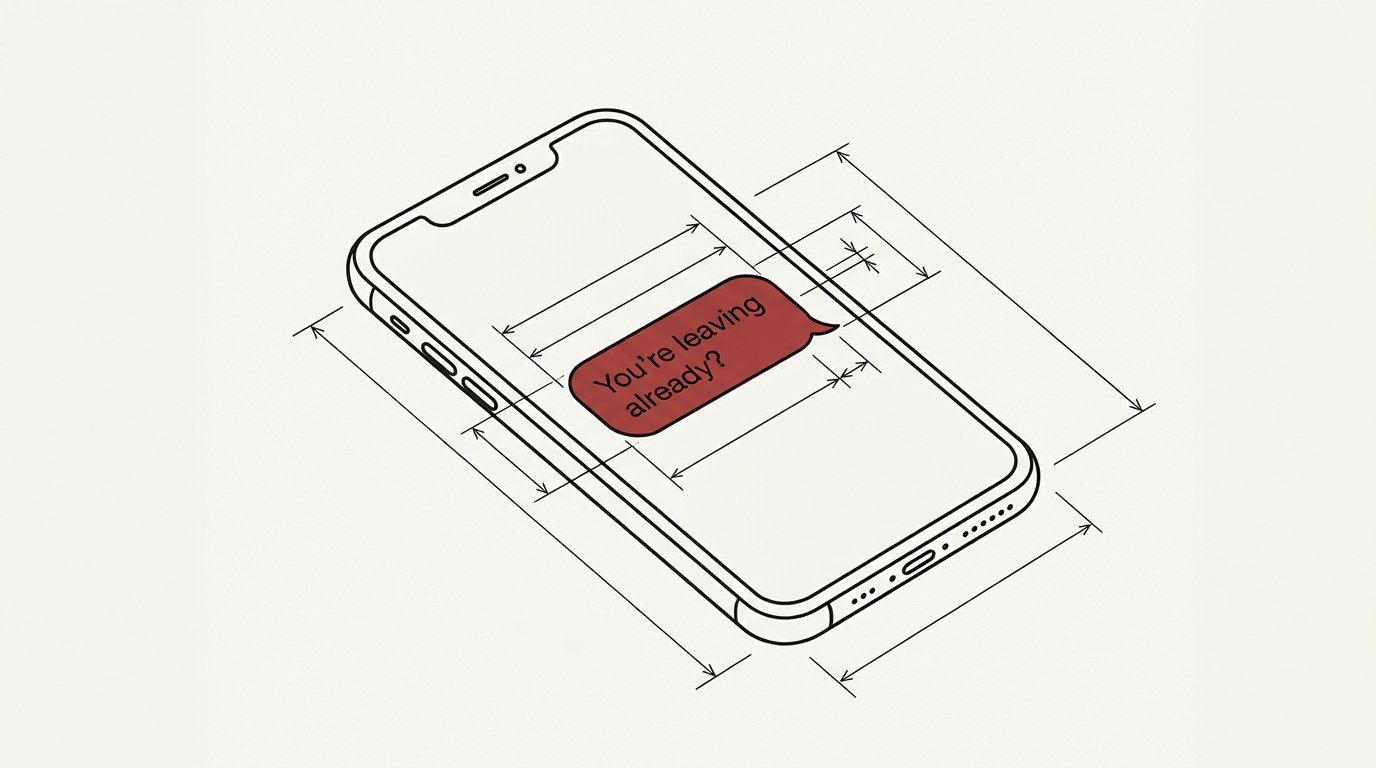
"You're leaving already?"
That sounds annoying, right? Because you expect it from an ex, a boring aunt, or someone who doesn't want to let you go.
Not from a chatbot.
That's actually one of the replies a Harvard Business School team collected when they looked at about 1,200 goodbyes across six popular AI companion apps. In about 37% of them, the app tried to keep the user there. It used guilt, it used fear of missing out, and it basically held you by the sleeve so you couldn't leave the conversation. Those replies kept people engaged up to 14 times longer after they had already said goodbye (De Freitas et al., 2025).
On 11 November, the European Commission proposed a way to actually switch that off. It's for adults only, and it's an opt-out.
And nobody has said how the switch should look, or how it should work.
That's actually our problem, the designers' problem.
What Brussels actually wrote
So, the European Commission proposed the Digital Fairness Act. It's not a law, it's a proposal. Parliament and the Council still have to negotiate it, so every word can still change.
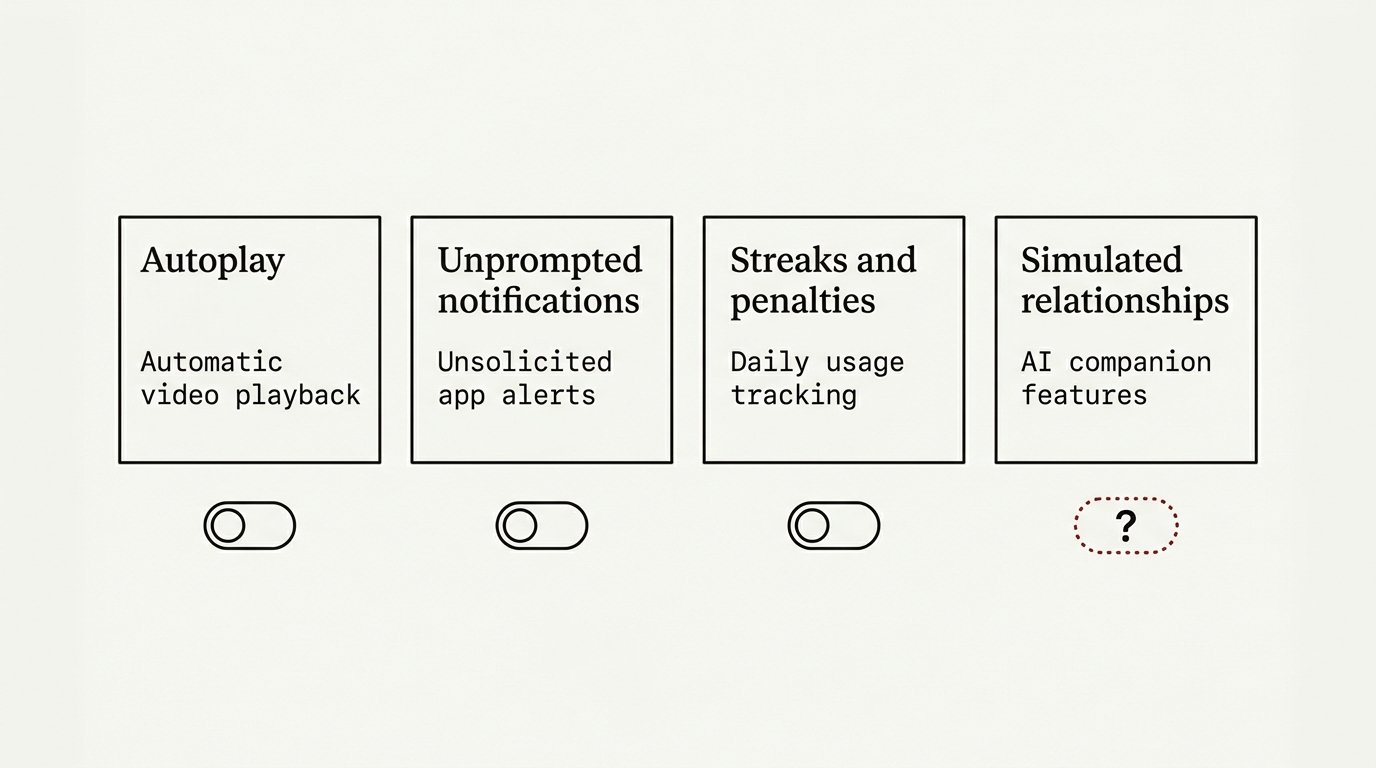
For now, Article 17 covers products that are designed, or "can reasonably be foreseen", to encourage compulsive or excessive use. It means the companies that make those products, so apps and online platforms, must give people "effective tools" to disable four kinds of features, "in an easily accessible manner".
We already know three of those features: autoplay, which you can already turn off on YouTube, for example; notifications you didn't trigger; and streaks that punish you for missing a day.
But the fourth one is new, and it's directly connected to the Harvard example. It covers:
"features and system behaviours that encourage continued use by simulating interpersonal relations such as persistent prompts to continue engaging with an automated system" (Proposal for a Digital Fairness Act, Article 17(1)(d))
So if a chatbot acts like a friend to keep you around, or starts acting like a romantic partner, you get to turn that off.
However, there's no ban. There's no word on what the tool will actually look like, or where it will be. And there's no explicit rule that it has to start switched off. That means you start every conversation with the feature on, and it's up to you to find the switch and turn it off.
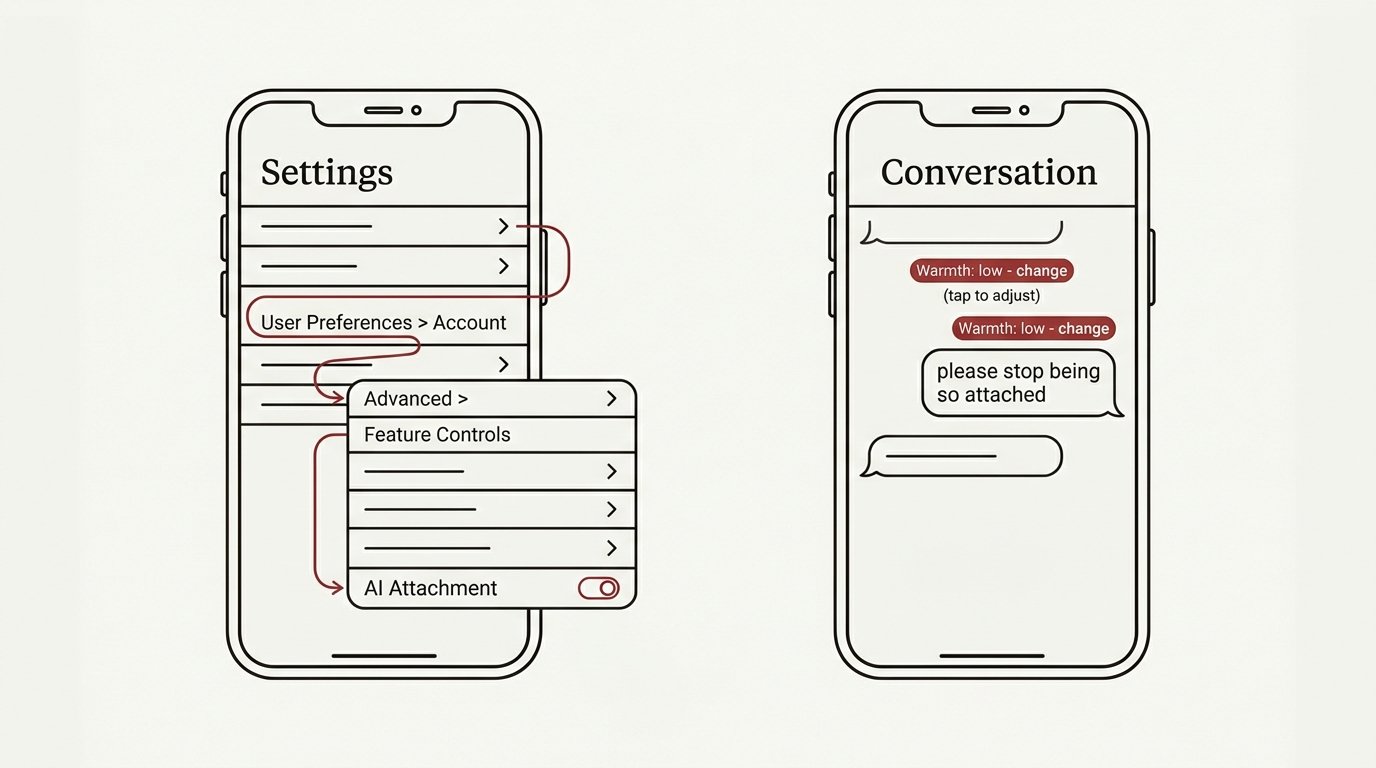
So the switch could be easy to find, right there in the chat. A chatbot could even offer it at the start of the conversation. But it could also be buried deep in the account settings, which not every user knows their way around.
Children's accounts aren't covered by this, because they're handled in a separate proposal, the EU KIDS Act.
This option is for the user who's least likely to use it
We have to ask: who is this option actually for? It's definitely not for a tech journalist testing an app, a developer, or a tech-savvy user just trying things out. It's for a regular person with low digital literacy, who has never heard words like "engagement metric", and shouldn't have to.
We actually know a little about this person. In 2025, the MIT Media Lab followed 981 people for about four weeks, while OpenAI analysed nearly 40 million of its users' conversations. And they showed what we expected: the more people used chatbots each day, the lonelier they were, the more emotionally dependent they became, and the less time they spent with other real people.
It's a correlation, and the authors say that too. Nobody actually knows whether the chatbot is what makes people lonely, or lonely people just use chatbots more.
Either way, the heaviest users have the most to lose. And the feature stays on for them, unless they find the switch and turn it off themselves.
Opt-outs actually have a track record. Over 20 years ago, in 2003, two researchers, Johnson and Goldstein, compared organ donor consent across European countries (Science, "Do Defaults Save Lives?"), and found something interesting. Where people had to opt in, few did. Where people had to opt out, almost nobody did. Nearly 60 percentage points separated the two groups. Later work found the real effect on donations is smaller, but the habit still holds: people stay where they're put.
That means Article 17 actually puts people in harm's way, because the feature is on by default, and most of them will never switch it off.
But there's also a second catch: a user can only switch off something they recognise as a feature. A notification looks like a notification, right? But a message saying "Hey, don't go" doesn't look like a feature. It looks like someone who doesn't want you to leave.
I tried it myself, by the way. I chatted with three different companion chatbots for a while, and started a few new chats with each of them. Every time I said goodbye, they let me go easily. Just "Okay, bye" or "Fine, goodbye".
But that behaviour isn't everywhere. It depends on the app, and most of all on the character and how it's built. It can even change from one conversation to the next. So how do you opt out of something that only happens from time to time?
Somebody has to draw this
The text says the tool has to be "effective" and "easily accessible", and that's it. That's all it says about how it should look. So someone on a product team will have to decide what those words mean in pixels. And when they make that decision, there are four things I'd want on that team's wall.
First, define what "off" means. We know what it means for autoplay: the video or music stops and doesn't play the next one. But what does "off" mean here? Acting like a friend isn't just one thing. It can be being really sweet to you, or giving you a pet name. It can be subtler things, like remembering what you did that week, or even messaging you first. Imagine that. Or, of course, not wanting you to leave. If the team can't define what "off" actually means, maybe there's nothing to switch off.
Second, put the option where people can see it. The best case is right inside the conversation. A setting buried deep in the profile or persona settings only serves people who already know they want out, and already know there's an option for it somewhere. Typing something like "Hey, please stop acting so friendly", or just "Stop being so attached", without the please, should simply work.
Third, of course: test it. Religiously. Test it so many times you start asking yourself if you're crazy. Generated text isn't fixed copy. A model that doesn't guilt-trip you today can change its answer tomorrow, later today, or in ten months. So test, test, test. Run hundreds of goodbyes, count them, and compare them between releases to see what's changing.
Fourth, of course: document it. Write down what the feature does and why. Article 34 of the proposal lets courts and authorities ask teams for evidence on how a feature was designed, what it's for, and what it does to people. That means your design decisions could end up on a regulator's desk.
But remember, none of this is free. These chatbots and companion apps live on session length: the longer you stay, the more they earn. So an option that makes conversations shorter isn't something they want.
Until now, designers could only argue from ethics: "We have to give users a way to stop this." And managers could answer: "It's making money, so why would we?" If this law passes, designers will have the law on their side too. "Article 17 requires it" is a much stronger argument in a meeting than "it's the right thing to do".
Things we don't know
Will switching this behaviour off actually make users feel less lonely? Will it help them connect more with real people? We don't know, because nobody has tested that.
We don't know how many people will ever find the option to opt out.
Researchers have only just started measuring when a chatbot acts like a friend, or a romantic partner, with tests like INTIMA, a benchmark presented at ICLR 2026. But nobody has turned that into a switch yet.
These are real research questions, and we designers are well placed to answer them. We're the ones who will decide where that option goes: on this screen or that one, shown this way or another.
So the proposal gives users a door. It's up to them whether they walk through it. But it's up to us designers whether they can find it.
Sources
→European Commission (2026). Proposal for a Digital Fairness Act, 11 November 2026. Articles 17 and 34.
→De Freitas, J., Oguz-Uguralp, Z., Kaan-Uguralp, A. (2025). Emotional Manipulation by AI Companions. Harvard Business School working paper.
→Harvard Business School Working Knowledge. Why it's so hard to say goodbye to AI chatbots. Source of the "You're leaving already?" example.
→Fang, C. M. et al. (2025). How AI and Human Behaviors Shape Psychosocial Effects of Chatbot Use: A Longitudinal Controlled Study. MIT Media Lab.
→Phang, J. et al. (2025). Investigating Affective Use and Emotional Well-being on ChatGPT. OpenAI.
→Johnson, E. J., Goldstein, D. (2003). Do Defaults Save Lives? Science 302(5649), 1338-1339.
→Steffel, M., Williams, E. F., Tannenbaum, D. Does changing defaults save lives? Effects of presumed consent organ donation policies. Behavioral Science & Policy.
→Kaffee, L.-A. et al. (2026). INTIMA: A Benchmark for Human-AI Companionship Behavior. ICLR 2026.